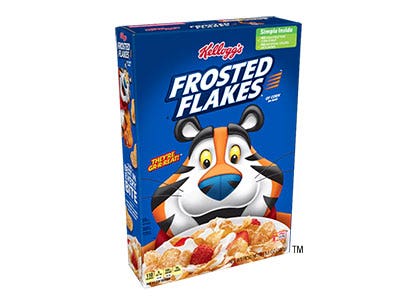
Kellogg’s® Frosted Flakes®, Kellogg’s Rice Krispies® and Kellogg’s Corn Flakes® are made with 4 simple ingredients, plus vitamins and minerals.
100% of Kellogg’s® cereals are free from high-fructose corn syrup.
We are eliminating artificial colors from our full cereal portfolio by the end of 2026
At WK Kellogg Co, we make eating well easy, staying true to our roots by offering cereal with simple ingredients and evolving to meet modern consumer preferences.
Many Kellogg’s® cereals are made with ingredients you’d find in your pantry - cooked in a similar way you’d make your grains at home, just in larger batches!
~75% of Kellogg’s® cereals are simply puffed, toasted, flaked, or shredded.1
*Nutrition information based on 1 large egg, ¾ cup skim milk, 170g plain, nonfat, Greek yogurt using USDA’s Food Data Central. 1 large egg 12%DV, ¾ cup skim milk 12% DV, 170g yogurt 34% DV, 1 serving Raisin Bran 4% DV, Frosted Mini Wheats 4% DV, Kashi Go Original 16%DV, Special K Protein 13%DV.
1 large egg contains 6 grams protein; a bowl of cereal with ¾ cup milk provides upwards of 6 grams protein*
Zhu Y, Jain N, Vanage V, Holschuh N, Agler A, Smith J. Association between ready-to-eat cereal consumption and nutrient intake, nutritional adequacy, and diet quality in adults in the national health and nutrition examination survey 2015–2016. Nutrients. (2019) 11:2952. doi: 10.3390/nu1112295
Did You Know
Cereal is a top source for fiber and whole grains for kids at breakfast.1
Look for Kellogg’s® cereal with 3g or more fiber per serving to help get to the recommended 28g each day!
Kellogg’s® Raisin Bran® and Frosted Mini Wheats® are high fiber cereals.
Wellness starts with fiber, but over 90% of people don’t get enough.2 Our fiber-focused cereals can help people close that gap. All-Bran® Original was among the first fiber focused cereals, launched almost a century ago!
Cereal brings fiber to the table, from whole grains and bran known to support digestive health and encourages pairing with other fiber containing foods like fruit.
We have more than 140 options that are at least a good source of fiber with 3-17g per serving, making it easy to find your fiber fix.
U.S. Department of Health and Human Services, Centers for Disease Control and Prevention, General Population, children ages 2-17 years old, [2017-2018].
U.S. Department of Agriculture; Agricultural Research Service. What We Eat in America: Nutrient intakes from food by gender and age. National Health and Nutrition Examination Survey (NHANES) 2009-10.
Did You Know
Over 90% of cereal is consumed with milk.1
Cereal is among the top foods fruit is paired with.2
Kids who eat cereal consume 50% more milk than those who don’t eat cereal.1
Cereal makes it easy to create balanced meals, bringing whole grains, fruit, and dairy together to give people choices they can feel good about.
Fortified ready-to-eat cereal is associated with increased diet quality as it often acts as a carrier food that increases milk and fruit intake.3
Building a bowl of cereal also fosters independence and choice. When mornings start early, cereal gives kids the ability to build a meal on their own by selecting a favorite cereal and adding other nourishing toppings.
Smith, J. D., Zhu, Y., Vanage, V., Jain, N., Holschuh, N., & Hermetet Agler, A. Association between ready-to-eat cereal consumption and nutrient intake, nutritional adequacy, and diet quality among infants, toddlers, and children in the national health and nutrition examination survey 2015–2016. Nutrients (2019) 11:1989. doi:10.3390/nu11091989
2020 PBH State of the Plate: America's Fruit & Vegetable Consumption Trends.
Wallace, T. C. (2025). Defining “Carrier Foods” – A Novel Basis for Evaluating Indirect Contributions to Diet Quality. Journal of the American Nutrition Association, 1–4. https://doi.org/10.1080/27697061.2025.2571635
Did You Know
Cereal is the #1 source of iron and folate in the diets of US children and adults.1
Cereal with milk is the #2 source of vitamin D and magnesium in US children’s diets.1
Cereal eaters get more key nutrients, but no more sodium or saturated fat than those who don’t eat cereal.1
Cereal provides essential nutrients and supports positive dietary patterns, helping people meet recommended intakes of key vitamins and minerals.
People who eat cereal and milk get more key nutrients than those who don't eat cereal, including under consumed nutrients like vitamin D, calcium, iron and folate.2
For under $1 per serving, a bowl of cereal can bring several key nutrients from grains, milk, and fruit together.3
Kellogg’s® cereal can provide iron, folate and B vitamins.
Zhu, Yong, et al. “Ready-To-Eat Cereal Is an Affordable Breakfast Option Associated with Better Nutrient Intake and Diet Quality in the US Population.” Frontiers in Nutrition, vol. 9, 9 Jan. 2023, https://doi.org/10.3389/fnut.2022.1088080.
Zhu Y, Jain N, Vanage V, Holschuh N, Agler A, Smith J. Association between ready-to-eat cereal consumption and nutrient intake, nutritional adequacy, and diet quality in adults in the national health and nutrition examination survey 2015–2016. Nutrients. (2019) 11:2952. doi: 10.3390/nu1112295
Based on the average national price of a serving of Kellogg’s cereal products with 4 or more servings per container, ¾ cup unflavored milk, and 2oz of bananas, apples, or strawberries. (Circana, L52W ending July 13, 2025)
Did You Know
Cereal eaters get no more added sugar in their diet than those who don’t eat cereal.1
Kellogg’s® has tasty options with single digit added sugar per serving like Kellogg’s Raisin Bran® and Kellogg’s Frosted Flakes® 25% Less Sugar.
Cereal drives intake of key nutrients and food groups, unlike the top sources of added sugar.2
Cereal offers a variety of sugar levels to fit your lifestyle, including options with single-digit added sugar- so you can enjoy great taste and nutrition.
Cereal is not one of the top 5 contributors of daily added sugar intake in US diets.3
Nearly half of our cereals have 10 grams or less of added sugar per serving, and over 75% of our cereals have 12 grams or less of added sugar per serving – that’s less than 50 calories from added sugar.4
Zhu, Yong, et al. “Ready-To-Eat Cereal Is an Affordable Breakfast Option Associated with Better Nutrient Intake and Diet Quality in the US Population.” Frontiers in Nutrition, vol. 9, 9 Jan. 2023, https://doi.org/10.3389/fnut.2022.1088080.
Zhu Y, Jain N, Vanage V, Holschuh N, Agler A, Smith J. Association between ready-to-eat cereal consumption and nutrient intake, nutritional adequacy, and diet quality in adults in the national health and nutrition examination survey 2015–2016. Nutrients. (2019) 11:2952. doi: 10.3390/nu1112295.
U.S. Department of Health and Human Services, Centers for Disease Control and Prevention, General Population, children ages 2-17 years old, [2017-2018].
This website uses cookies so that we can provide you with the best user experience. To learn more and to change your cookie settings, click “Cookie Preferences.” Otherwise, click “OK” to continue. Learn more about WK Kellogg Co's use of your data by reading our Privacy Notice.
Privacy Preference Center
When you visit our websites, we store and retrieve information on your browser, mostly in the form of cookies. This information relates to you, your preferences or your device and is mostly used to make the site work as you expect it to. The information does not usually directly identify you, but it can give you a more personalized web experience. Because we respect your right to privacy, you can choose not to allow some types of cookies. Click on the different category headings to find out more and change our default settings. However, blocking some types of cookies may impact your experience of the site and the services we are able to offer.
You can manage your cookies at any time by clicking the link “Cookie Preferences” in the footer of the website to access this Privacy Preference Center. Please see our Privacy Notice for further information on the technologies we use, their purpose, how we process your data and your rights as a data subject.
More information
Manage Consent Preferences
Strictly Necessary Cookies
Always Active
These cookies are necessary for the website to function and cannot be switched off in our systems. They are usually only set in response to actions made by you which amount to a request for services, such as setting your privacy preferences, logging in or filling in forms. You can set your browser to block or alert you about these cookies, but some parts of the site will not then work. These cookies do not store any personally identifiable information.
Functional Cookies
These cookies enable the website to provide enhanced functionality and personalisation. They may be set by us or by third party providers whose services we have added to our pages. If you do not allow these cookies then some or all of these services may not function properly.
Performance Cookies
These cookies allow us to count visits and traffic sources so we can measure and improve the performance of our site. They help us to know which pages are the most and least popular and see how visitors move around the site. All information these cookies collect is aggregated and therefore anonymous. If you do not allow these cookies we will not know when you have visited our site, and will not be able to monitor its performance.
Targeting Cookies
These cookies may be set through our site by our advertising partners. They may be used by those companies to build a profile of your interests and show you relevant adverts on other sites. They do not store directly personal information, but are based on uniquely identifying your browser and internet device. If you do not allow these cookies, you will experience less targeted advertising.
Cookie List
label
ConsentLeg.Interest
label
label
label
FAQs
What are good breakfast cereals for adults?
WK Kellogg offers a variety of breakfast cereals that cater to adults seeking nutritious options. Here are some good choices:
Kashi Go Original: High in protein (16% DV per serving) and fiber, this cereal is ideal for adults looking for a balanced and nutrient-dense breakfast.
Special K Protein: Provides 13% DV of protein per serving, making it a great option for those focused on maintaining energy and muscle health.
Raisin Bran: Known for its outstanding fiber content, this cereal supports digestive health and is a classic choice for adults.
Frosted Mini-Wheats: Offers a good balance of fiber and essential nutrients, making it a filling and wholesome breakfast option.
Low FODMAP Certified Cereals: WK Kellogg provides cereals certified as low FODMAP, catering to adults with sensitive digestive systems.
These cereals are fortified with key nutrients like vitamin D, calcium, iron, and folate, and are often paired with milk and fruit to create a balanced meal.
What are good breakfast cereals for seniors?
WK Kellogg offers a variety of nutritious cereals that can be great options for seniors, focusing on fiber, vitamins, and minerals to support overall health. Here are some recommendations:
Kellogg's® Raisin Bran®: This cereal is high in fiber, which supports digestive health, and includes raisins for added sweetness and nutrients.
Kellogg's® All-Bran®: Known for its high fiber content, this cereal is ideal for maintaining digestive health, which is especially important for seniors.
Kellogg's® Special K® Original: A fortified cereal with added vitamins and minerals, including B vitamins and iron, which are beneficial for seniors.
Kashi® Honey Toasted Oats®: A certified organic cereal available in the WIC program, offering whole grains and a nutritious option for seniors.
Low FODMAP Certified Cereals: WK Kellogg provides several cereals certified by Monash University as low FODMAP, making them suitable for seniors with sensitive digestive systems. Examples include Kellogg's® Frosted Krispies®, Corn Flakes®, and Rice Krispies®.
These cereals can be paired with milk, yogurt, or fresh fruit to create a balanced and nutrient-rich breakfast.
What cereals are easy to eat and digest for seniors?
Cereals can be an excellent option for seniors as they are easy to prepare, eat, and digest. Ready-to-eat cereals, such as Kellogg’s Raisin Bran®, provide essential nutrients like fiber, vitamins, and minerals, which are beneficial for digestive health and overall nutrition. Pairing cereal with milk adds protein, vitamin D, and calcium, further supporting bone health and dietary needs. Additionally, cereals are versatile and can be customized with fruits or other toppings to enhance flavor and nutrition.
What breakfast foods are appropriate for older adults?
WK Kellogg offers a variety of breakfast foods that are nutritious and suitable for older adults. Many of their cereals are made with simple ingredients, such as grains, and are fortified with essential nutrients like vitamin D, calcium, iron, and folate, which are often under-consumed by older adults. Additionally, their cereals provide fiber from grains and bran, supporting digestive health, and protein, which is important for maintaining muscle mass.
Cereal can be paired with milk and fruit to create a balanced meal, making it an easy and convenient option for older adults. WK Kellogg also offers low FODMAP certified cereals, which may be beneficial for individuals with sensitive digestive systems.
what ingredients and nutrition info does WK Kellogg Co Frosted Flakes 25% Less Sugar provide
Ingredients: Kellogg’s Frosted Flakes® with 25% Less Sugar is made with four simple ingredients: corn, sugar, malt, and salt, plus added vitamins and minerals.
Nutrition Information: This cereal is fortified with 8 essential vitamins and minerals, including:
Vitamin D
Iron
Niacin
Thiamin
Riboflavin
Vitamin B6
Vitamin B12
Folic acid
It contains 25% less added sugar compared to the original Kellogg’s Frosted Flakes®, offering a lower-sugar option while maintaining its signature taste.
Are there online yogurt parfait recipes that use cereal like Frosted Mini-Wheats?
Here is an online recipe for a Strawberry Yogurt Parfait using Kellogg’s® Frosted Mini-Wheats® cereal:
Ingredients:
3/4 cup plain whole milk yogurt
1 tablespoon honey
3/4 cup Kellogg’s® Frosted Mini-Wheats® cereal, lightly crushed
1/2 cup sliced fresh or frozen strawberries
Directions:
In a small bowl, mix the yogurt and honey.
In a large glass, layer 1/4 cup of crushed Kellogg’s® Frosted Mini-Wheats® cereal, 1/3 of the strawberries, and half of the yogurt mixture.
Repeat the layers once. Garnish with the remaining cereal and strawberries.
This recipe takes 5 minutes to prepare and makes 1 serving. For more recipes, visit WK Kellogg's website.
Can I find an online blueberry crisp recipe that uses cereal as a topping?
The recipe for an Apple Crisp Bowl on the WK Kellogg website can be adapted to include blueberries for a blueberry crisp. The recipe uses cereal as a topping and can be found here.
Are there online overnight breakfast recipes that include cereal?
WK Kellogg offers an Overnight Subway Slammer recipe that includes cereal as part of its overnight breakfast options. You can find the recipe on their website.
Can cereal be part of a healthy diet?
WK Kellogg Co emphasizes that cereal can be a key part of a healthy diet. Their cereals provide essential nutrients, including vitamin D, calcium, iron, and folate, which are often under-consumed. Cereal eaters tend to have better nutrient intake and diet quality compared to non-cereal eaters. Additionally, cereal acts as a 'carrier food,' encouraging the consumption of milk and fruit, which further enhances diet quality. Many Kellogg’s cereals are made with simple ingredients, such as puffed, toasted, flaked, or shredded grains, making them a convenient and nutritious option for balanced meals.
What should parents look for in a breakfast cereal?
According to WK Kellogg Co, parents should look for the following in a breakfast cereal to ensure it contributes to a nutritious breakfast:
Nutritious Grains: Choose cereals made with high fiber, whole grains, or fortified options with added vitamins and minerals. For example, cereals like Kellogg’s Raisin Bran® are good choices.
Low Added Sugar: Opt for cereals with less than 5g of added sugar per serving, such as Rice Krispies®, Kellogg's Corn Flakes®, Crispix®, or Special K® Original.
Fortification: Look for cereals that are fortified with essential vitamins and minerals to help meet daily nutritional needs.
Pairing with Other Food Groups: Combine cereal with dairy (like milk or yogurt) and fresh fruit (such as bananas, strawberries, or blueberries) to create a balanced meal.
Natural Ingredients: Consider cereals made with simple, recognizable ingredients and natural colors derived from fruit, vegetable juices, or plant-based sources.
By selecting cereals that meet these criteria, parents can provide a breakfast that is both nutritious and enjoyable for their children.
What helps support digestion in the morning?
For a breakfast that supports digestion, consider including cereals high in fiber, such as Kellogg’s Raisin Bran® or cereals with psyllium fiber. Fiber is an important part of overall wellness and digestive health. Pairing these cereals with milk, yogurt, or fresh fruit like bananas or berries can create a balanced and nutritious morning meal.
Are there online recipes for Mini-Wheats Pick-a-Mix?
While the website does not provide specific recipes for Mini-Wheats Pick-a-Mix, it highlights versatile ideas for using Frosted Mini-Wheats® cereal in recipes. One example is the Frosted Mini-Wheats® Strawberry Yogurt Parfait, which combines crushed cereal, strawberries, and a yogurt-honey mixture. You can explore variations by pairing Mini-Wheats with fruits, nuts, seeds, and yogurt to create your own breakfast combinations or snacks.
Are there online recipes for Kellogg’s® Special K® cookies?
You can explore Kellogg’s® Special K® cookie recipes online by visiting the Special K Recipes page. This page offers a variety of recipes, including those for cookies and other delicious treats made with Special K® cereal.